.svg)
🧠 Sales Psychology

Why Psychology is KING
Sales is extremely varied, and with enough quantity, anything works, literally.
Asking “how are you?” in cold calls works.
Being overly pushy works.
This is because humans are extremely varied, and different things work.
However, the way our minds work is overall consistent.
If you base your sales methodology around psychology, you will succeed more often.
It’s not about what works and what doesn’t.
It’s about what has the highest % chance of working.
Leverage psychology and you’ll work less to get better results.
Infographic
Below you’ll find the most relevant psychological principle for sales.
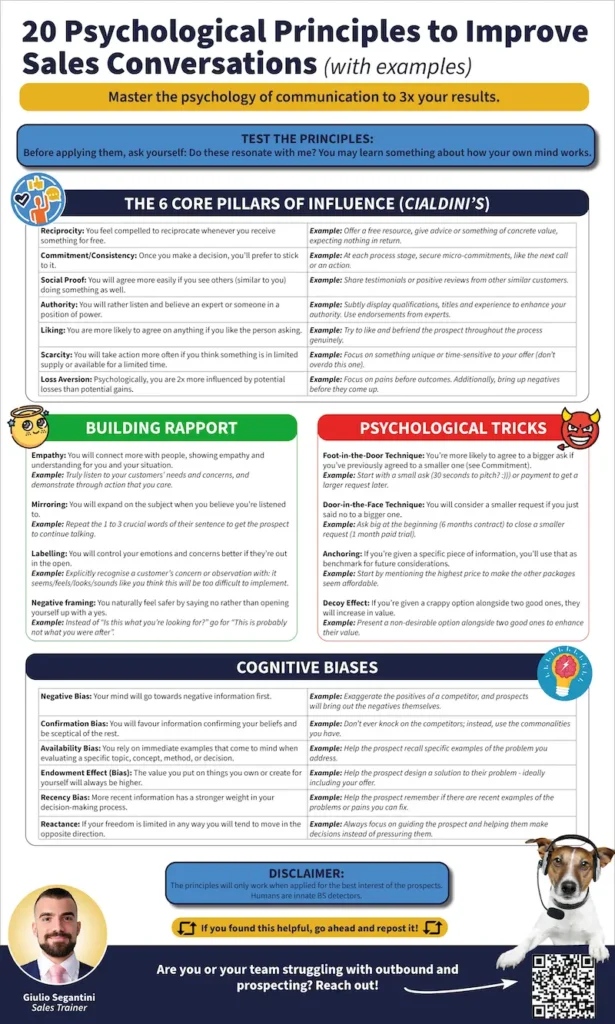
Psychology in Cold Calling
Let’s look at the most important psychological principles and why they apply in cold calls.
Everyone’s Favourite Topic
What is every single human being’s favourite topic?
Think about it.
That’s right.
Themselves.
Focus on them and not on you.
Don’t sell how good you are.
Talk about the problems you fix.
Make it ALL about them.
Reactance
The innate strive of any human being for freedom.
Throughout history more people willingly died for freedom and their rights than any other reason.
This is the main reason why I believe in permission-based openers.
The more freedom you give the prospect, the more open they will be.
It’s also why I often ask permission before asking questions.
The more the prospect feels in control, the deeper you can go.
Loss Aversion
Humans are 2x as likely to move away from pain than they are to move toward pleasure.
Which is precisely why you want to lead with problems and focus on them.
Poor salespeople focus on features.
Good salespeople focus on benefits.
Great salespeople focus on problems.
Stay on the problems.
Negative Framing
Saying no gives a sense of control.
Conversely, every yes opens us up to risk in the modern commercial world.
This is why going for no will make the prospect feel safer.
Phrases like:
- Would it be a bad idea…
- Would you be against…
- I guess you don’t struggle with these..
They’re softer asks and trigger the desire of the prospect to correct you.
What’s better?
- The prospect agrees they have a problem
- The prospect argues that he does have a problem
Go for no.
Availability Bias
Prospects can only fix problems if they recognise they’re real.
Anything becomes real only if you can think of a tangible example.
This is why getting the prospect to come up with an example of the problem is crucial.
That’s what makes the problem real.
Always ask for an example of the problem.
Once you have that, the meeting is almost always guaranteed.
Struggling with Cold Calling?
Or join 300K Followers Social Media: